US Considers Requiring Permits for Nvidia, AMD Global AI Chip Sales
The Pulse — US Proposes AI Chip Export Permits for Nvidia, AMD
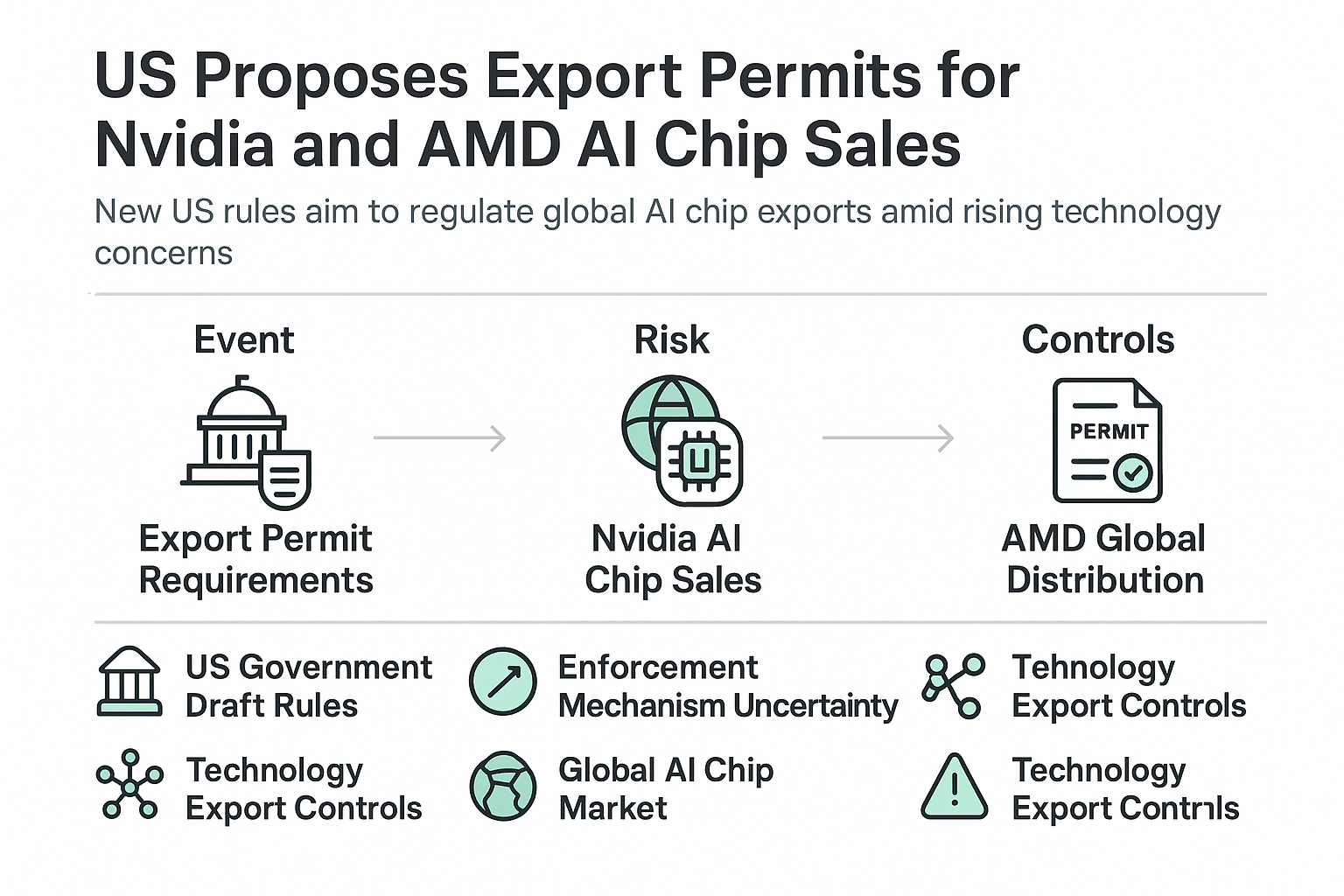
AISFY Pulse analyzes major AI events through governance, accountability, and execution control. The US government is drafting rules to require export permits for global sales of AI chips produced by Nvidia and AMD. The scope, timeline, and enforcement mechanisms of these proposed controls remain unknown. Evidence strength = Low.
Source: Bloomberg
What Happened? — US Drafts Export Controls on AI Chip Sales
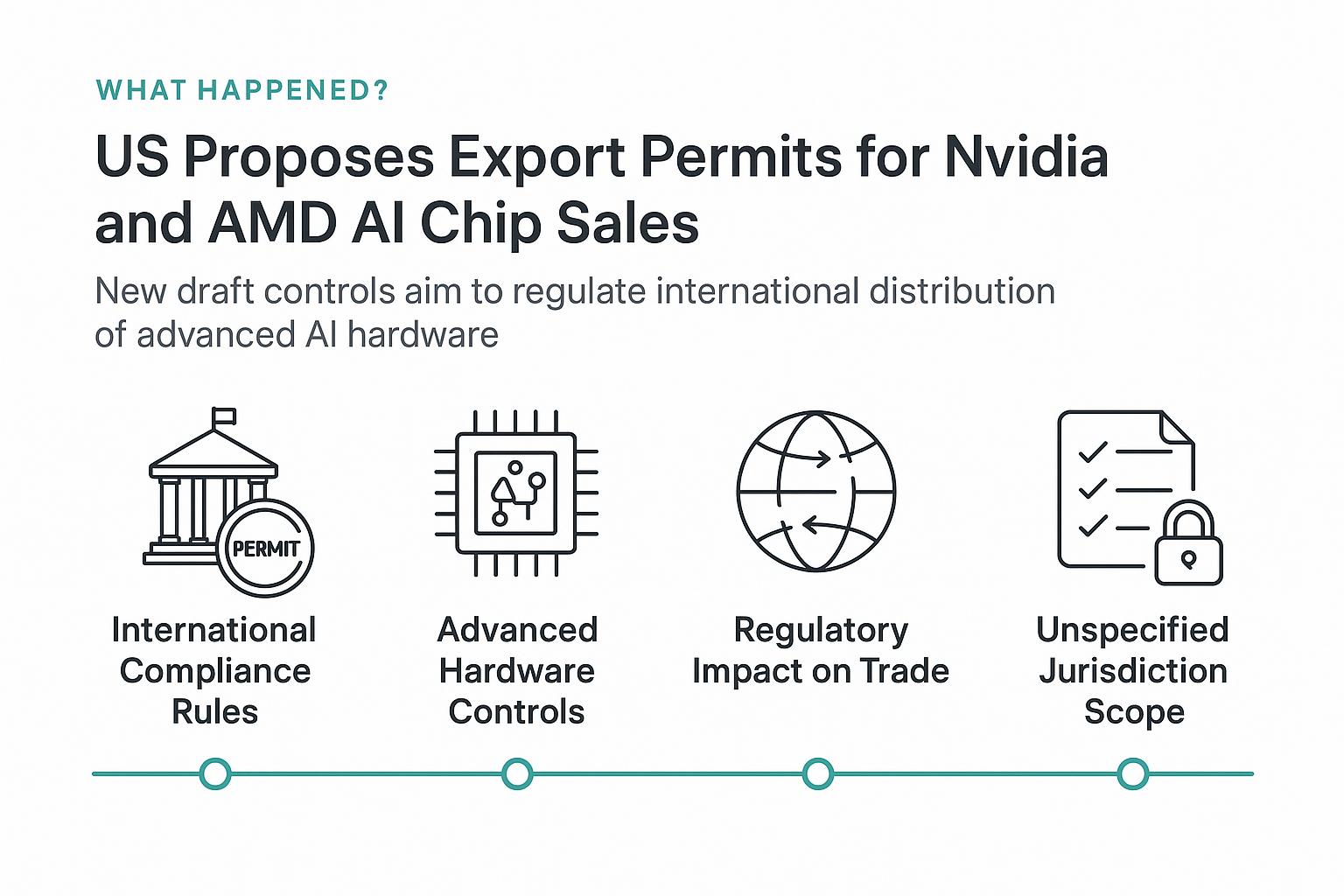
The US is considering regulatory measures that would mandate permits for Nvidia and AMD to sell AI chips internationally. The objective appears to be exerting control over the global distribution of advanced AI hardware. Specific details about the permit process, affected jurisdictions, or compliance requirements are not disclosed.
What Are The Risks Involved? — Supply Chain and Compliance Risk from Export Controls
Primary risk vector: Regulatory compliance and supply chain disruption due to export permit requirements.
Risk |
Mechanism in this event |
Impact |
Mandatory vs Contextual |
Supply chain disruption |
Export permits delay or restrict chip sales |
Delays in AI hardware availability globally |
Mandatory |
Vendor compliance risk |
Nvidia and AMD must navigate complex permit rules |
Increased operational and legal costs |
Mandatory |
Geopolitical risk |
Export controls may escalate trade tensions |
Market fragmentation and reduced cooperation |
Contextual |
Innovation slowdown |
Restricted chip access limits AI development |
Potential delay in AI product rollouts |
Contextual |
Enforcement ambiguity |
Lack of clarity on permit scope and process |
Compliance uncertainty and risk of violations |
Contextual |
Who Is Affected? — Enterprise AI Governance Roadmap Impacted
Stakeholder group |
Impact in this event |
Inherited governance risk |
Accountability owner |
Product Management |
Delays in AI product timelines due to hardware access |
Supply chain and compliance risk |
Head of Product |
Legal & Compliance |
Must interpret and enforce new export permit rules |
Regulatory compliance and export control risk |
Chief Legal Officer |
AI Engineering |
Potential hardware shortages affect model training |
Operational risk from hardware unavailability |
AI Engineering Lead |
Responsible AI Oversight |
Increased complexity in supply chain transparency |
Oversight gaps on hardware provenance |
Responsible AI Officer |
Cybersecurity/DevSecOps |
Need to secure export-controlled hardware data |
Data handling and export compliance risk |
CISO |
Risk Management |
Elevated geopolitical and compliance risks |
Risk assessment and mitigation complexity |
Chief Risk Officer |
Audit & Assurance |
Requirement to audit export compliance |
Audit trail and evidence management |
Internal Audit Lead |
End Users / Customers |
Possible delays or higher costs for AI-enabled products |
Service disruption and trust impact |
Customer Success Manager |
This event impacts the full AI governance lifecycle from strategy and product planning through legal compliance, engineering, risk, and audit. It underscores the need for integrated corporate AI governance operating models that incorporate export control compliance. AI governance maturity models must adapt to geopolitical regulatory risks. The AI policing AI community should monitor evolving export control enforcement to inform adaptive governance tooling.
Why This Matters for AI Governance? — Balancing Innovation and Regulatory Oversight
This event highlights the governance tension between enabling rapid AI innovation and enforcing national security-driven export controls. The opacity of permit requirements and the diffusion of hardware supply chains complicate accountability and post-deployment oversight. Enterprises must navigate an evolving AI governance framework that integrates export compliance without stifling AI development. The UNESCO Recommendation on the Ethics of Artificial Intelligence emphasizes human rights and societal well-being, underscoring the need for proportional and transparent governance mechanisms in such regulatory interventions.
How Governance Frameworks Apply (Practical)? — NIST AI RMF Guides Risk and Compliance Integration
The NIST AI Risk Management Framework (AI RMF) provides a practical approach to map, measure, manage, and govern AI risks including those arising from supply chain and regulatory compliance. Enterprises should incorporate export control risk mapping into their AI lifecycle governance, measure compliance readiness, manage permit acquisition workflows, and govern ongoing adherence through continuous monitoring. This event calls for integrating export control considerations into AI governance frameworks to ensure robust risk management and accountability.
What Needs to Be Built Next (Controls Blueprint)? — Export Compliance Controls for AI Hardware
Control |
Purpose |
Lifecycle Stage |
Decision Authority |
Applicable Guidelines / Standards / Laws |
Mandatory vs Contextual |
Evidence / Artifact |
Trigger / Signal |
Export Permit Management |
Ensure timely acquisition of required permits |
Pre-deployment |
Legal & Compliance |
ISO/IEC 23894, Export Control Laws |
Mandatory |
Permit applications and approvals |
New export control regulations |
Supply Chain Risk Assessment |
Identify hardware supply vulnerabilities |
Planning & Procurement |
Risk Management |
ISO/IEC 23894 |
Mandatory |
Risk assessment reports |
Changes in export control policies |
Compliance Training |
Educate teams on export control obligations |
Ongoing |
Legal & HR |
ISO/IEC 23894 |
Mandatory |
Training records |
Onboarding and regulatory updates |
Audit Trail for Export Controls |
Maintain evidence of compliance activities |
Post-deployment |
Audit & Assurance |
ISO/IEC 23894 |
Mandatory |
Audit logs and compliance reports |
Permit renewals and audits |
Incident Response for Violations |
Rapid response to export control breaches |
Incident Management |
CISO & Legal |
ISO/IEC 23894 |
Contextual |
Incident reports |
Detection of non-compliance or breaches |
The Build — Governance by Design for AI Chip Export Controls
Governance for AI chip export controls must address the intersection of national security regulation and enterprise AI supply chain management. The system boundary includes regulatory compliance workflows, supply chain risk management, and audit readiness for export permits.
Design Axioms (Non-Negotiables)
- Governance systems must enforce export permit requirements before hardware deployment.
- Compliance evidence must be immutable and audit-ready.
- Export control risk assessments must be integrated into AI lifecycle governance.
- Governance must not impede transparency needed for accountability.
- Incident response must include export control violation protocols.
- Governance must protect enterprise data and IP during compliance processes.
Governance Architecture (Control-Plane vs Execution-Plane)
Layer |
What it contains |
What it controls |
Failure prevented |
Evidence produced |
Control-Plane |
Export compliance policies, permit workflows |
Permit acquisition and compliance tracking |
Unauthorized hardware export |
Permit records, compliance logs |
Execution-Plane |
AI hardware procurement and deployment |
Hardware usage aligned with export rules |
Supply chain breaches |
Procurement records, deployment logs |
Runtime Enforcement Loop (Gates + Signals)
1. Regulatory Affairs reviews new export control rules (Decision Owner: Legal & Compliance).
2. Risk Management updates supply chain risk profile (Decision Owner: Chief Risk Officer).
3. Product Management adjusts AI hardware procurement plans (Decision Owner: Head of Product).
4. Compliance team initiates export permit applications (Decision Owner: Legal & Compliance).
5. Audit team verifies permit acquisition and documentation (Decision Owner: Internal Audit Lead).
6. Incident Response team monitors and addresses violations (Decision Owner: CISO).
Failure Modes → Design Countermeasures
Failure mode |
Why it happens |
Design countermeasure |
Runtime signal |
Residual risk |
Permit acquisition delays |
Complex or unclear permit processes |
Automated permit tracking and alerts |
Delayed permit approvals |
Moderate |
Non-compliance with export rules |
Lack of awareness or training |
Mandatory compliance training |
Compliance audit failures |
High |
Supply chain disruption |
Export restrictions limit hardware flow |
Diversified supplier strategy |
Hardware shortages |
Moderate |
Incomplete audit trails |
Poor documentation practices |
Immutable logging systems |
Missing compliance records |
High |
Incident response gaps |
Unclear violation protocols |
Defined export violation response plan |
Unresolved compliance incidents |
High |
Minimum Evidence Pack (Audit-Ready)
- Export permit documents proving legal authorization
- Risk assessment reports showing supply chain evaluation
- Training completion certificates for export compliance
- Audit logs demonstrating permit tracking and usage
- Incident reports for export control violations
- Procurement records linking hardware to permits
- Compliance policies outlining export control requirements
- Communication records with regulatory authorities
Effective governance design integrates export control compliance into AI supply chain and lifecycle management. Enforcement loops ensure timely permit acquisition and incident response, while audit-ready evidence supports accountability. This approach mitigates risks of regulatory breaches and supply chain disruption, enabling enterprises to navigate geopolitical constraints without compromising AI innovation velocity.