Amazon launches AI-enabled platform to automate healthcare administrative tasks
The Pulse — Amazon’s AI Platform Automates Healthcare Admin Tasks

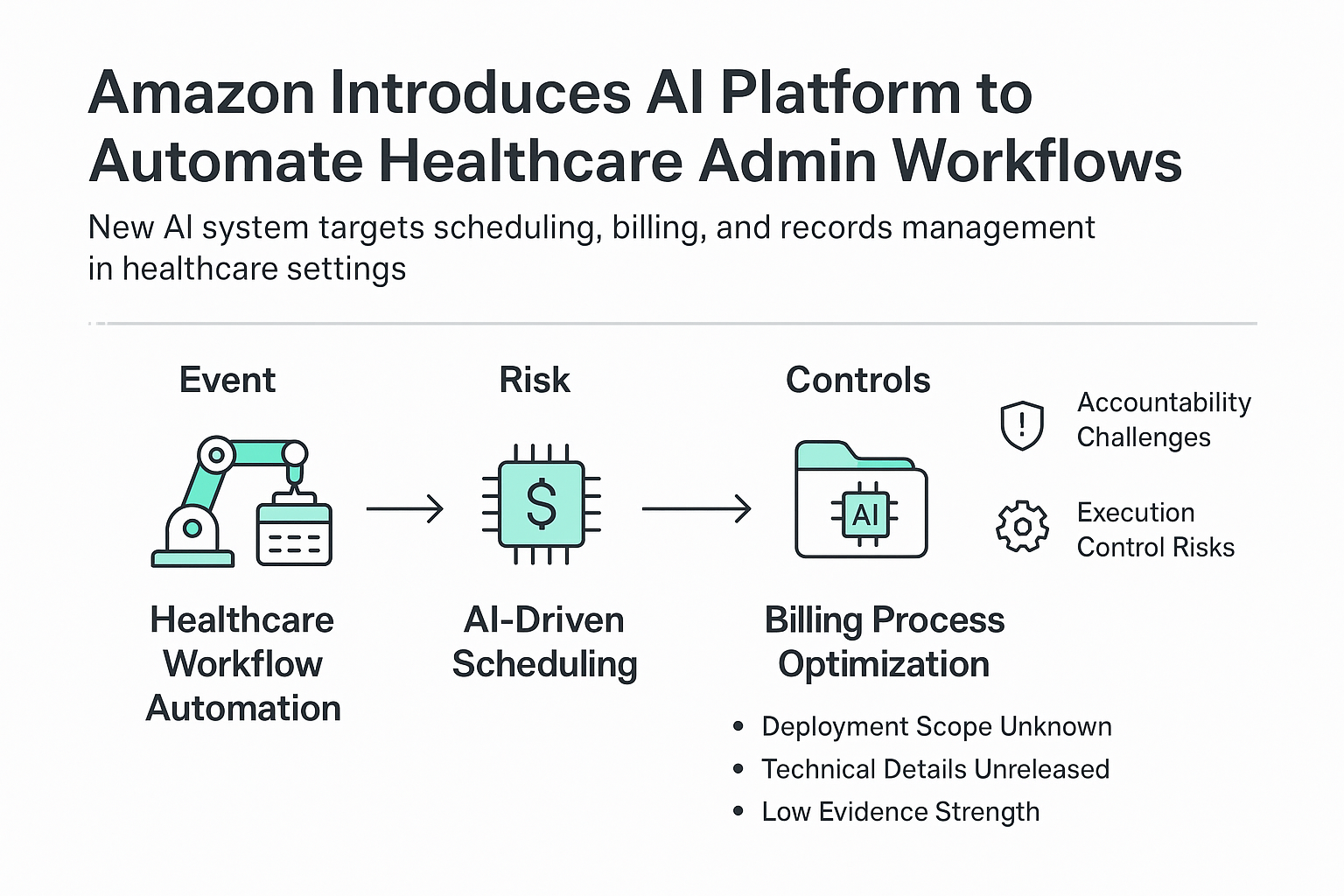
AISFY Pulse analyzes major AI events through governance, accountability, and execution control. Amazon has launched a new AI-enabled platform designed to automate administrative tasks within healthcare settings. The platform aims to streamline workflows such as scheduling, billing, and records management by leveraging AI capabilities. Specific technical details, deployment scope, and timelines remain UNKNOWN. Evidence strength = Low.
Source: Reuters
What Happened? — Amazon Introduces AI for Healthcare Admin Automation

Amazon announced the release of an AI-powered platform targeting healthcare administrative processes. The system is intended to reduce manual workload by automating routine tasks like appointment scheduling and claims processing. No detailed information is available on the AI models used, data governance measures, or integration with existing healthcare IT systems. The timeline for rollout and geographic coverage is also UNKNOWN.
What Are The Risks Involved? — Automation Risks in Sensitive Healthcare Admin
Classification: Operational and compliance risk in healthcare AI automation.
Primary risk vector: Potential errors or biases in AI-driven administrative decisions impacting patient data accuracy and billing integrity.
Risk |
Mechanism in this event |
Impact |
Mandatory vs Contextual |
Data privacy breaches |
AI platform processes sensitive patient information |
Unauthorized data exposure, regulatory fines |
Mandatory |
Automation errors |
AI misclassifies or mishandles administrative tasks |
Billing errors, appointment mismanagement |
Mandatory |
Compliance gaps |
Lack of transparency or audit trails |
Violations of healthcare regulations |
Mandatory |
Vendor lock-in and dependency |
Reliance on Amazon’s proprietary AI system |
Reduced operational flexibility |
Contextual |
Insufficient human oversight |
Overreliance on AI without adequate review |
Undetected errors, patient safety risks |
Mandatory |
Who Is Affected?
Stakeholder group |
Impact in this event |
Inherited governance risk |
Accountability owner |
Product Management |
Must integrate AI platform into healthcare workflows |
Risk of misaligned product features and compliance |
Product Lead |
Legal & Compliance |
Ensures regulatory adherence and data privacy |
Exposure to HIPAA and healthcare laws |
Chief Compliance Officer |
AI Engineering |
Develops and maintains AI models and platform |
Model bias, error rates, data handling risks |
AI Model Owner |
Responsible AI Oversight |
Monitors ethical use and fairness |
Lack of transparency and auditability |
AI Ethics Officer |
Cybersecurity |
Protects platform and data from breaches |
Data leakage and cyberattack vulnerabilities |
CISO |
Risk Management |
Assesses operational and reputational risks |
Inadequate risk mitigation strategies |
Chief Risk Officer |
Internal Audit |
Reviews controls and compliance |
Insufficient evidence for audits |
Head of Internal Audit |
Healthcare Providers |
End users relying on accurate admin processes |
Workflow disruption and patient impact |
Clinical Operations Lead |
This event spans the AI governance lifecycle from product design through deployment and ongoing oversight. Corporate AI governance maturity models must incorporate vendor risk management and cross-functional accountability. AI governance operating models should embed continuous monitoring and audit readiness. The AI policing AI community benefits from transparency on AI decision-making in regulated sectors.
Why This Matters for AI Governance? — Balancing Automation and Accountability in Healthcare
This event highlights the governance tension between operational efficiency and maintaining rigorous oversight in sensitive healthcare environments. Automated administrative AI introduces opacity in decision-making and potential drift in task execution, complicating accountability. Enterprise AI governance frameworks must address these challenges by enforcing transparency, auditability, and human-in-the-loop controls. The UNESCO Recommendation on the Ethics of Artificial Intelligence underscores the necessity of human rights preservation and societal well-being in AI deployment, particularly in healthcare. This event exemplifies the need for robust AI governance accountability and oversight mechanisms to manage risks inherent in healthcare AI automation.
How Governance Frameworks Apply (Practical)? — Applying NIST AI RMF to Healthcare AI Automation
The NIST AI Risk Management Framework (AI RMF) provides a practical structure for mapping, measuring, managing, and governing AI risks in this context. Mapping involves identifying healthcare administrative tasks automated by Amazon’s platform and associated data flows. Measuring requires assessing model performance, bias, and error rates on healthcare datasets. Managing includes implementing controls for data privacy, human oversight, and compliance with healthcare regulations. Governing entails establishing policies, roles, and continuous monitoring to ensure accountability and transparency. Integrating NIST AI RMF into the AI governance operating model supports systematic risk reduction and compliance assurance for this AI platform.
What Needs to Be Built Next (Controls Blueprint)? — Controls for Healthcare AI Lifecycle Governance
Control |
Purpose |
Lifecycle Stage |
Decision Authority |
Applicable Guidelines / Standards / Laws |
Mandatory vs Contextual |
Evidence / Artifact |
Trigger / Signal |
Data Privacy Impact Assessment |
Evaluate patient data handling risks |
Pre-deployment |
Chief Privacy Officer |
HIPAA, ISO/IEC 23894 |
Mandatory |
DPIA report |
New data source integration |
Human-in-the-Loop Review |
Ensure human oversight on critical decisions |
Deployment & Operation |
Product Safety Lead |
ISO/IEC 23894 |
Mandatory |
Review logs, override records |
Anomaly detection in AI outputs |
Model Performance Monitoring |
Track accuracy and bias in administrative tasks |
Operation |
AI Model Owner |
ISO/IEC 23894 |
Mandatory |
Performance dashboards |
Performance degradation alerts |
Audit Trail and Logging |
Maintain transparent records for compliance |
Operation |
Internal Audit |
HIPAA, ISO/IEC 23894 |
Mandatory |
Audit logs |
Scheduled audit cycles |
Vendor Risk Management |
Manage dependency and contractual obligations |
Procurement & Operation |
Risk Management |
ISO/IEC 23894 |
Contextual |
Vendor risk assessments |
Contract renewal or incident reports |
These controls establish a governance foundation for AI execution approval, AI decision control, and AI lifecycle risk management aligned with ISO/IEC 23894. They enable continuous oversight and enforce accountability across the AI lifecycle.
The Build — Governance by Design for Healthcare AI Automation
Effective governance for Amazon’s healthcare AI platform requires embedding controls from design through operation within the healthcare administrative ecosystem. The system boundary includes AI models, data inputs, user interfaces, and integration points with healthcare IT infrastructure. Governance must ensure data privacy, human oversight, and compliance with healthcare regulations while enabling operational efficiency.
Design Axioms (Non-Negotiables)
- Governance systems must enforce patient data privacy by design.
- AI decisions must not be executed without human review in critical cases.
- Auditability of all AI-driven administrative actions must be guaranteed.
- Vendor risk must be continuously assessed and mitigated.
- Transparency of AI decision logic must be accessible to oversight functions.
- Governance must prevent unauthorized automation beyond defined task scope.
Governance Architecture (Control-Plane vs Execution-Plane)
Layer |
What it contains |
What it controls |
Failure prevented |
Evidence produced |
Control-Plane |
Policies, roles, compliance frameworks |
AI model deployment, data access |
Unauthorized data use, compliance |
Policy documents, compliance reports |
Execution-Plane |
AI platform runtime, user interfaces |
Task automation, human override |
Automation errors, oversight gaps |
Logs, audit trails, override records |
Runtime Enforcement Loop (Gates + Signals)
1. Data Privacy Officer reviews new data inputs (Decision Owner: Chief Privacy Officer)
2. AI Model Owner validates model updates and performance metrics (Decision Owner: AI Model Owner)
3. Product Safety Lead approves deployment with human-in-the-loop controls (Decision Owner: Product Safety Lead)
4. CISO monitors cybersecurity and data protection alerts (Decision Owner: CISO)
5. Internal Audit reviews audit trails and compliance reports (Decision Owner: Head of Internal Audit)
6. Risk Management evaluates incident reports and vendor risk (Decision Owner: Chief Risk Officer)
Failure Modes → Design Countermeasures
Failure mode |
Why it happens |
Design countermeasure |
Runtime signal |
Residual risk |
Data breach |
Insufficient access controls |
Enforce strict access policies |
Unauthorized access alerts |
Medium |
Automation error |
Model misclassification or bias |
Human-in-the-loop review |
Anomaly detection in outputs |
Medium |
Compliance violation |
Lack of audit trails or transparency |
Comprehensive logging and audits |
Missing audit logs |
Low |
Vendor dependency risk |
Overreliance on proprietary system |
Vendor risk assessments and contracts |
Vendor incident reports |
Contextual |
Minimum Evidence Pack (Audit-Ready)
- Data Privacy Impact Assessment report proving risk evaluation
- Model performance and bias monitoring dashboards
- Human-in-the-loop review logs and override records
- Comprehensive audit trail logs for AI actions
- Vendor risk assessment documentation
- Compliance certification aligned with healthcare regulations
- Incident and anomaly detection reports
- Governance policy and role assignment documents
Embedding these governance elements ensures AI execution control and accountability in healthcare administrative automation. The design and enforcement architecture collectively prevent unsafe AI use, maintain regulatory compliance, and preserve patient trust while enabling operational efficiencies.