Anthropic launches AI job destruction detector
The Pulse — Anthropic’s AI Job Destruction Detector Launch
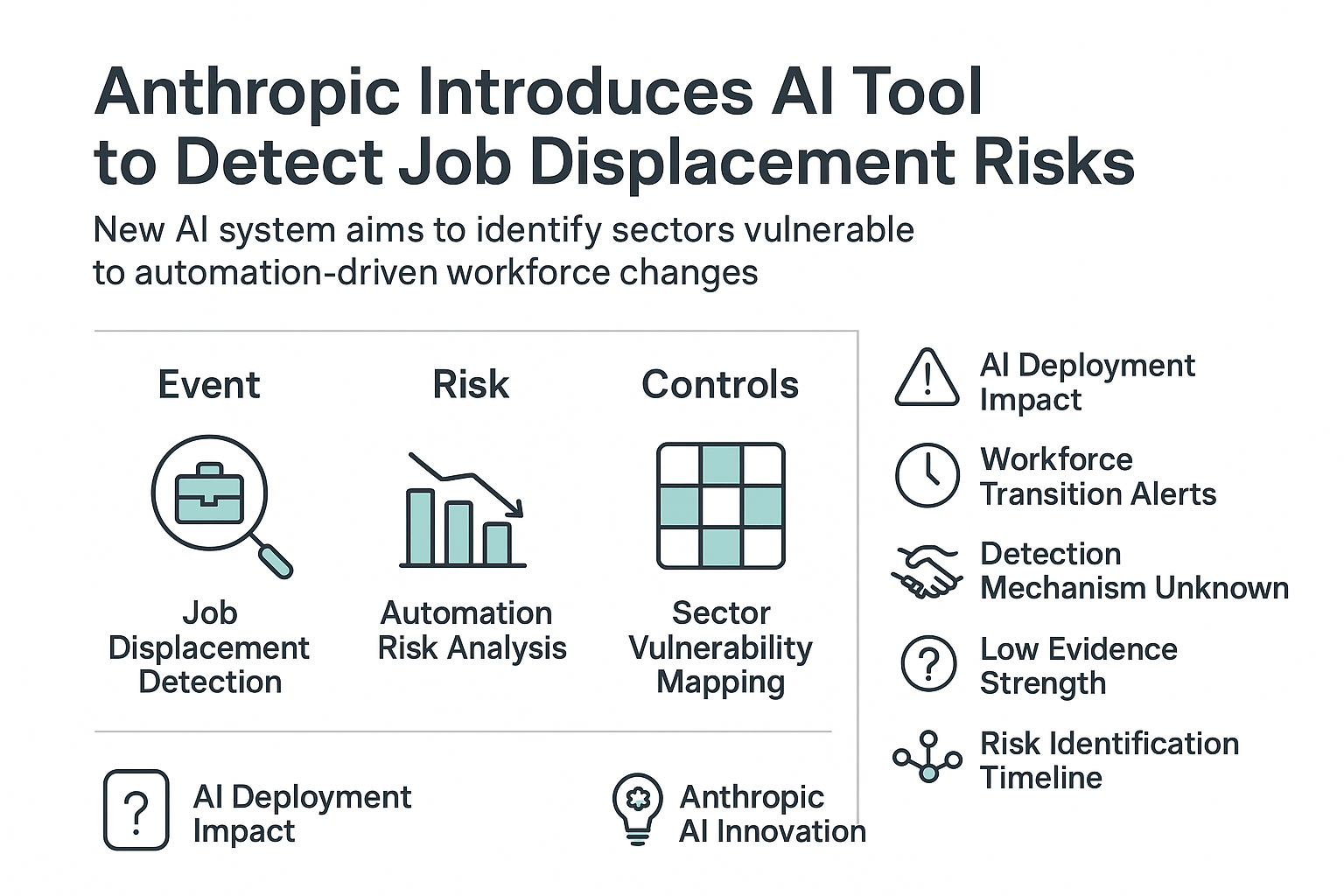
AISFY Pulse analyzes major AI events through governance, accountability, and execution control. Anthropic has launched a new AI tool designed to detect potential job destruction risks caused by AI deployment. The tool aims to identify sectors and roles at risk of automation-driven displacement. Details on the detection mechanisms, scope, and deployment timeline remain UNKNOWN. Evidence strength = Low.
Source: Axios
What Happened? — Introduction of AI Job Displacement Detection Tool
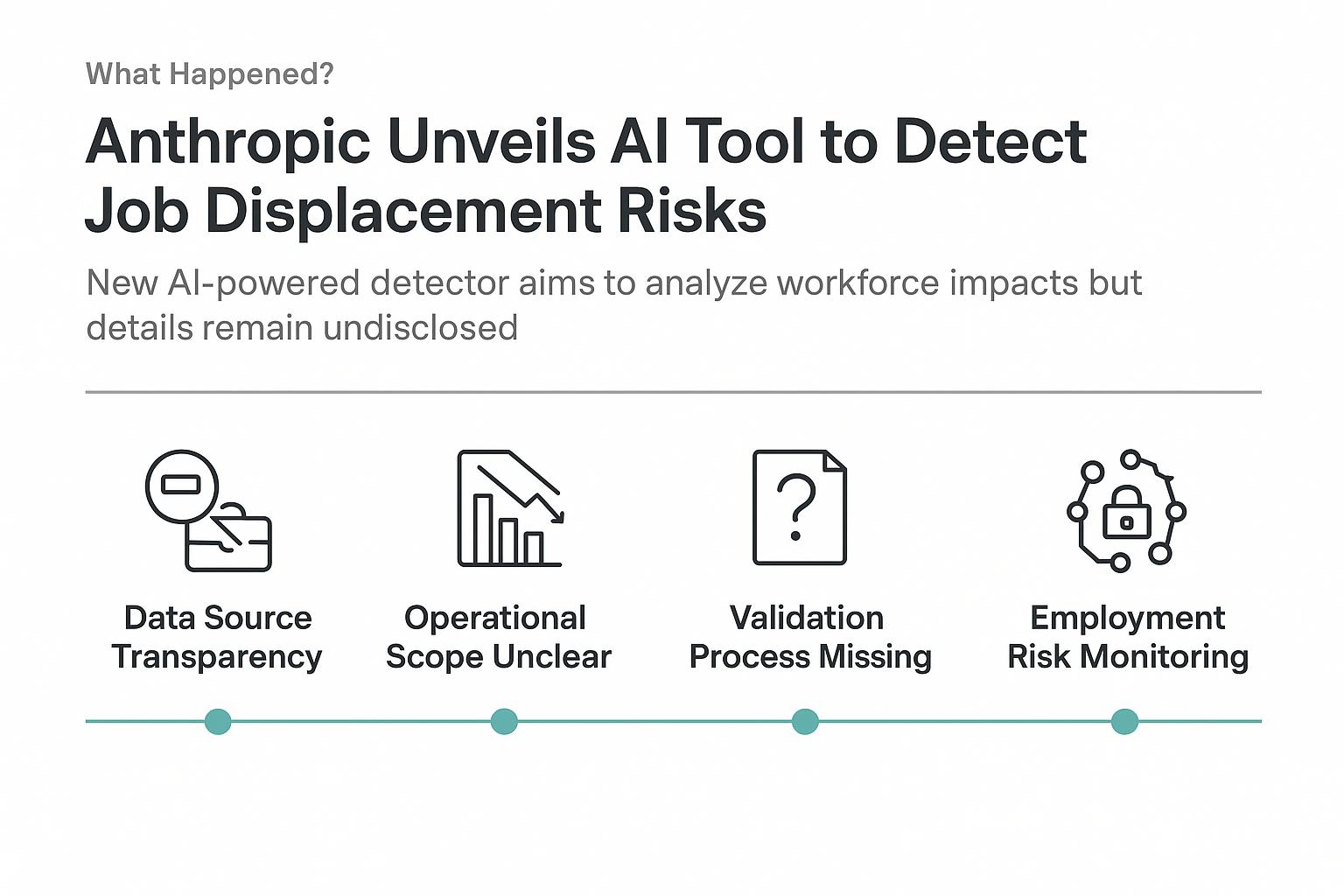
Anthropic announced the release of an AI-powered job destruction detector intended to assess the impact of AI systems on employment. The tool presumably analyzes AI adoption effects on workforce dynamics but lacks disclosed technical specifics, operational scope, or integration plans. No information is available on data sources, detection algorithms, or validation processes.
What Are The Risks Involved? — Emerging Risks from AI Impact Detection
Classification: Emerging operational and reputational risk from AI impact monitoring tools.
Primary risk vector: Inaccurate or incomplete detection leading to misinformed decisions on AI deployment and workforce management.
Risk |
Mechanism in this event |
Impact |
Mandatory vs Contextual |
False positives/negatives |
Undisclosed detection algorithms and data bias |
Misallocation of resources; workforce disruption |
Contextual |
Lack of transparency |
Unknown model explainability and auditability |
Reduced trust by stakeholders |
Mandatory |
Vendor dependency |
Reliance on third-party AI impact assessment |
Vendor lock-in; limited internal control |
Contextual |
Insufficient governance |
Absence of clear governance frameworks |
Compliance gaps; regulatory scrutiny |
Mandatory |
Ethical oversight gaps |
Potential neglect of human rights considerations |
Harm to worker dignity and societal trust |
Mandatory |
Who Is Affected? — Corporate AI Governance Stakeholders
Stakeholder group |
Impact in this event |
Inherited governance risk |
Accountability owner |
Product Management |
Decision-making on AI feature deployment |
Misjudging AI impact on jobs |
Head of Product |
Legal & Compliance |
Regulatory risk from labor and AI laws |
Non-compliance with labor protections |
Chief Legal Officer |
AI Engineering |
Integration of detection tool with AI systems |
Technical risk from opaque detection models |
AI Engineering Lead |
Responsible AI/Oversight |
Monitoring ethical implications of AI adoption |
Insufficient impact assessment governance |
Responsible AI Officer |
Cybersecurity/DevSecOps |
Securing data and model integrity |
Data privacy and model manipulation risks |
CISO |
Risk & Compliance |
Managing operational and reputational risks |
Incomplete risk identification and mitigation |
Chief Risk Officer |
Audit & Assurance |
Verifying accuracy and compliance of detection |
Lack of audit trails and evidence |
Internal Audit Lead |
HR & Workforce Planning |
Planning workforce transitions and retraining |
Poorly informed workforce impact strategies |
Head of HR |
This event impacts the full AI governance lifecycle from strategy through execution and oversight. It highlights the need for integrated corporate AI governance roadmaps that align detection tools with ethical, legal, and operational controls. AI policing AI communities should focus on transparency and auditability standards for impact detection models.
Why This Matters for AI Governance? — Balancing AI Impact Transparency and Accountability
This event surfaces a governance tension between the need for transparency in AI’s socioeconomic effects and the opacity of AI detection tools. Oversight becomes harder due to limited visibility into detection methodologies and potential drift in AI impact predictions post-deployment. The lack of disclosed mechanisms challenges accountability frameworks and risks undermining trust in AI governance. According to the UNESCO Recommendation on the Ethics of Artificial Intelligence, governance must ensure human rights protection, societal well-being, and oversight proportionality, all of which are at risk without clear transparency and auditability in impact detection.
How Governance Frameworks Apply (Practical)? — Applying NIST AI RMF to AI Impact Detection
The NIST AI Risk Management Framework (AI RMF) provides a practical approach to map, measure, manage, and govern AI risks, including those from AI impact detection tools. Enterprises should map the detection tool’s risk profile, measure its accuracy and bias, manage operational and ethical risks through controls, and govern ongoing compliance and transparency. This includes establishing workflows for continuous monitoring, validation, and stakeholder communication. The framework’s emphasis on explainability and human oversight is critical given the unknowns in the detection tool’s design and deployment.
What Needs to Be Built Next (Controls Blueprint)? — Controls for AI Job Impact Detection
Control |
Purpose |
Lifecycle Stage |
Decision Authority |
Applicable Guidelines / Standards / Laws |
Mandatory vs Contextual |
Evidence / Artifact |
Trigger / Signal |
Transparency & Explainability |
Ensure detection outputs are interpretable |
Design & Deployment |
AI Governance Board |
ISO/IEC 23894 |
Mandatory |
Model documentation; explanation logs |
Model update; stakeholder inquiry |
Bias & Fairness Audits |
Detect and mitigate bias in detection algorithms |
Development & Testing |
Responsible AI Officer |
ISO/IEC 23894 |
Mandatory |
Audit reports; bias metrics |
Periodic review; incident reports |
Data Privacy Safeguards |
Protect sensitive workforce data |
Data Collection |
CISO |
ISO/IEC 23894; GDPR (contextual) |
Mandatory |
Data access logs; privacy impact assessment |
Data breach; access request |
Governance Integration |
Embed detection tool in AI governance roadmap |
Deployment |
Chief Risk Officer |
ISO/IEC 23894 |
Contextual |
Governance policies; risk registers |
New AI deployment; risk escalation |
Continuous Monitoring & Validation |
Track detection accuracy and update models |
Post-Deployment |
AI Engineering Lead |
ISO/IEC 23894 |
Mandatory |
Monitoring dashboards; validation tests |
Performance degradation; anomaly detection |
The Build — Governance by Design for AI Job Impact Detection
Effective governance of AI job destruction detection tools requires a system boundary encompassing data integrity, model transparency, ethical oversight, and operational risk management. The governance design must integrate controls across the AI lifecycle to prevent misuse, bias, and opacity.
Design Axioms (Non-Negotiables)
- Detection models must be explainable to relevant stakeholders.
- Data used must comply with privacy and consent requirements.
- Bias mitigation must be embedded throughout model development.
- Governance policies must mandate continuous monitoring and validation.
- Detection outputs must not be used autonomously for workforce decisions without human oversight.
- Audit trails must be maintained for all detection-related decisions.
Governance Architecture (Control-Plane vs Execution-Plane)
Layer |
What it contains |
What it controls |
Failure prevented |
Evidence produced |
Control-Plane |
Governance policies, audit frameworks |
Model transparency, compliance |
Undetected bias, non-compliance |
Policy documents, audit logs |
Execution-Plane |
Detection algorithms, data pipelines |
Data integrity, model accuracy |
Data breaches, inaccurate outputs |
Monitoring reports, validation tests |
Runtime Enforcement Loop (Gates + Signals)
1. Model update approval by AI Governance Board.
2. Bias and fairness audit by Responsible AI Officer.
3. Data privacy compliance check by CISO.
4. Deployment authorization by Chief Risk Officer.
5. Continuous performance monitoring by AI Engineering Lead.
6. Incident response and remediation by Product Safety team.
Failure Modes → Design Countermeasures
Failure mode |
Why it happens |
Design countermeasure |
Runtime signal |
Residual risk |
Model opacity |
Lack of explainability |
Mandatory explainability documentation |
Stakeholder complaints |
Moderate |
Data privacy breach |
Insufficient data safeguards |
Enforced data access controls |
Unauthorized access alerts |
High |
Biased detection outcomes |
Unchecked training data bias |
Regular bias audits and retraining |
Bias audit failures |
Moderate |
Governance policy gaps |
Incomplete integration |
Governance roadmap alignment |
Policy non-compliance reports |
Moderate |
Model drift post-deployment |
Lack of continuous validation |
Continuous monitoring and retraining |
Performance degradation alerts |
Moderate |
Minimum Evidence Pack (Audit-Ready)
- Model architecture documentation proving explainability.
- Bias audit reports demonstrating fairness.
- Data privacy impact assessments confirming compliance.
- Governance policy documents showing integration.
- Monitoring dashboards evidencing continuous validation.
- Incident logs detailing response actions.
- Deployment approval records from governance board.
- Training data provenance records ensuring data integrity.
This governance design ensures AI job destruction detection tools operate transparently, ethically, and securely. By embedding controls across design, deployment, and runtime, enterprises can mitigate risks of workforce harm and regulatory non-compliance while maintaining trust and accountability.