Bitterly ironic' Trump is wrecking his AI agenda with Anthropic spat, lobbyists and ex-officials say
The Pulse — Trump’s AI agenda disrupted by Anthropic conflict
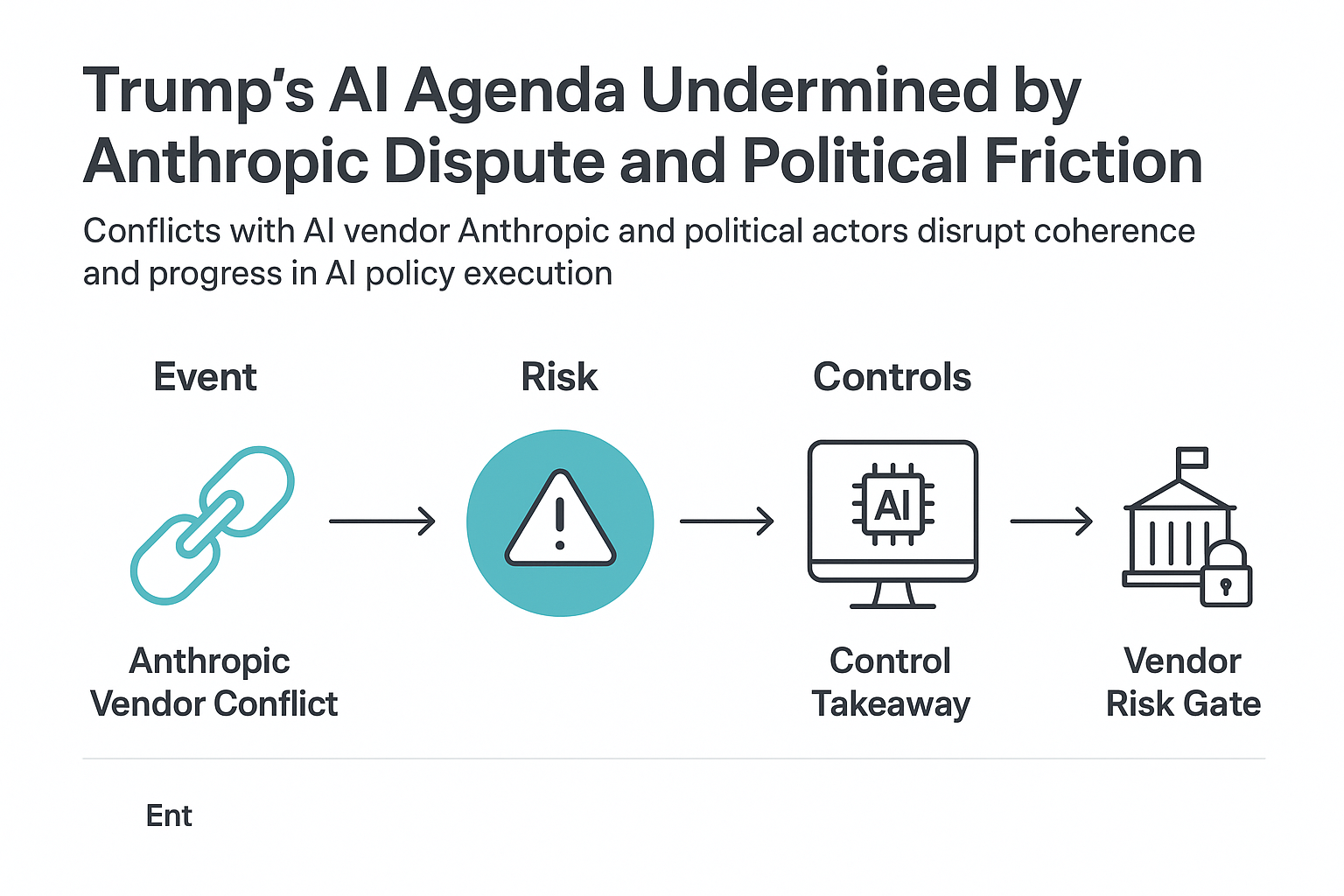
AISFY Pulse analyzes major AI events through governance, accountability, and execution control. Former US President Trump’s AI policy ambitions are reportedly being undermined by a public dispute with Anthropic, a prominent AI vendor, according to lobbyists and ex-officials cited by Politico. This conflict is affecting the coherence and progress of the administration’s AI agenda. Evidence strength = Low.
Source: Politico
What Happened? — Public spat disrupts AI policy coherence
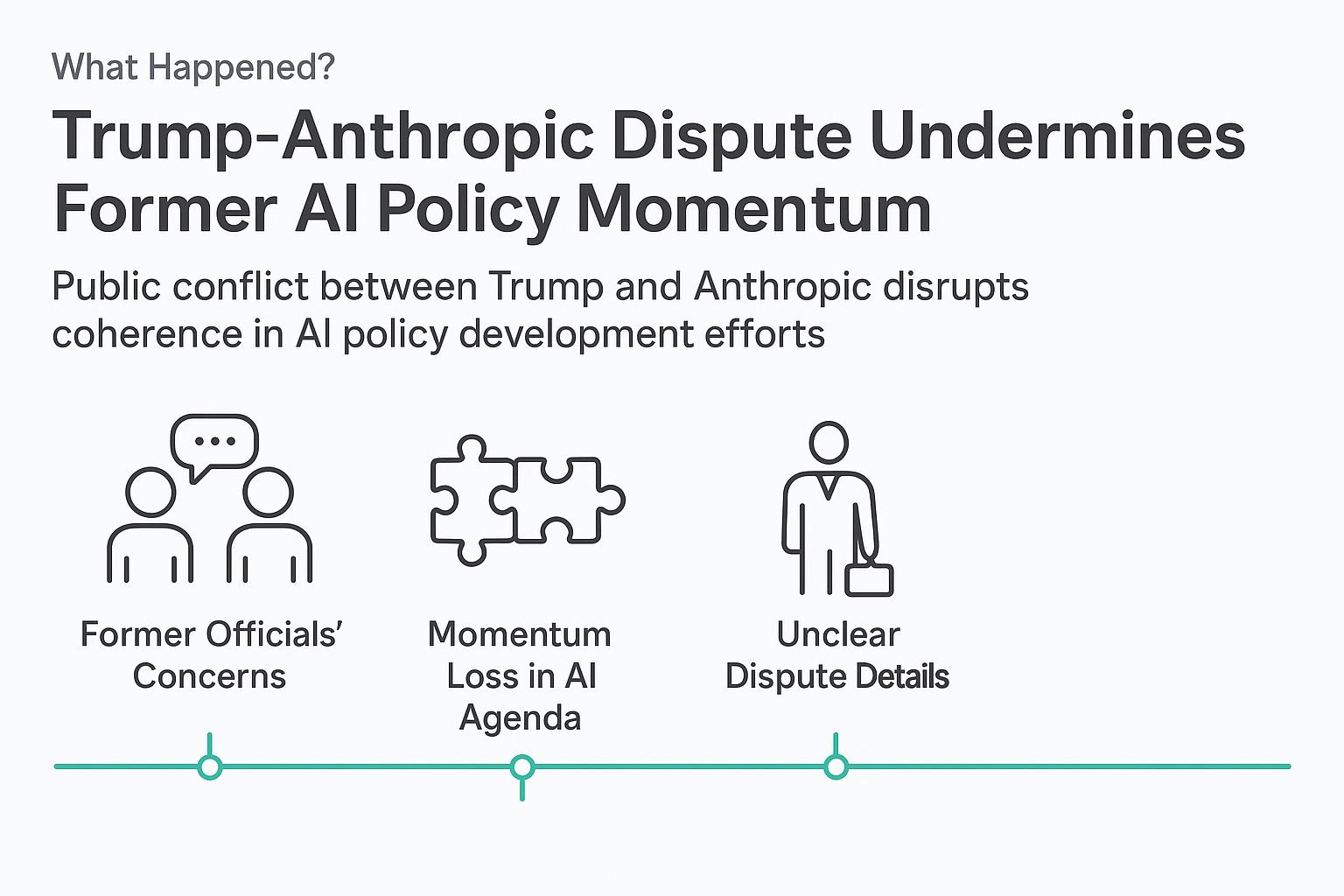
A public disagreement between Trump and Anthropic has emerged, reportedly damaging the former administration’s AI agenda. Lobbyists and former officials suggest this conflict is causing fragmentation and loss of momentum in AI policy efforts. Specific details on the nature of the dispute, its scope, or timeline are unknown.
What Are The Risks Involved? — Policy fragmentation risks AI governance gaps
Primary risk vector: Disrupted AI policy coordination leading to governance fragmentation.
Risk |
Mechanism in this event |
Impact |
Mandatory vs Contextual |
Governance fragmentation |
Public vendor dispute undermines policy unity |
Delayed or inconsistent AI regulation |
Contextual |
Vendor risk escalation |
Breakdown in vendor-government relations |
Increased uncertainty in AI adoption |
Contextual |
Policy drift and incoherence |
Loss of centralized AI agenda control |
Reduced oversight and accountability |
Contextual |
Who Is Affected?
Stakeholder group |
Impact in this event |
Inherited governance risk |
Accountability owner |
Strategy/Product |
AI agenda disruption affects product roadmaps |
Misaligned AI strategy and vendor selection |
Chief Product Officer |
Data/Privacy/Legal |
Unclear policy guidance on AI data use |
Compliance gaps and legal uncertainty |
Chief Privacy Officer |
AI Engineering/Architecture |
Vendor disputes delay AI integration decisions |
Technical risk from uncertain vendor stability |
AI Engineering Lead |
Responsible AI/Oversight |
Oversight mechanisms weakened by policy incoherence |
Reduced AI accountability frameworks |
Head of Responsible AI |
Cybersecurity/DevSecOps |
Security policies may lack alignment |
Increased vulnerability due to governance gaps |
Chief Information Security Officer |
Risk/Compliance/Incident Response |
Risk management hindered by unclear policy direction |
Elevated operational and compliance risks |
Chief Risk Officer |
Audit/Assurance |
Audit scope unclear due to shifting governance |
Incomplete assurance coverage |
Internal Audit Lead |
End users/impacted stakeholders |
Potentially inconsistent AI service quality |
User trust erosion |
Customer Experience Manager |
This event impacts the entire AI governance lifecycle from strategy through execution and oversight, increasing risks of policy drift and operational uncertainty. The AI policing community should monitor vendor-government dynamics as a critical factor in governance stability.
Why This Matters for AI Governance? — Governance tension from policy fragmentation
This event highlights a governance tension between centralized policy control and vendor relations, increasing opacity and diffusion of accountability. The public dispute undermines coherent AI governance frameworks, complicating oversight and enforcement of AI safety and ethical standards. According to the UNESCO Recommendation on the Ethics of Artificial Intelligence, such fragmentation threatens human rights and societal well-being by weakening governance accountability and proportionality. Enterprise AI governance frameworks must anticipate and mitigate risks from political and vendor conflicts to maintain robust AI oversight mechanisms.
How Governance Frameworks Apply (Practical)? — NIST AI RMF guides risk management amid policy disruption
The NIST AI Risk Management Framework (AI RMF) provides a practical approach to map, measure, manage, and govern AI risks even when policy coherence is challenged. Enterprises should apply AI RMF principles to maintain governance continuity by identifying risk sources from vendor disputes, measuring impact on AI lifecycle stages, managing operational controls, and governing through adaptive oversight. This framework supports resilience against external governance shocks by embedding risk management into AI deployment and vendor management workflows.
What Needs to Be Built Next (Controls Blueprint)? — ISO/IEC 23894 informs controls for vendor-related governance risks
Control |
Purpose |
Lifecycle Stage |
Decision Authority |
Applicable Guidelines / Standards / Laws |
Mandatory vs Contextual |
Evidence / Artifact |
Trigger / Signal |
Vendor Risk Assessment |
Evaluate vendor stability and alignment |
Pre-deployment |
AI Governance Board |
ISO/IEC 23894 |
Mandatory |
Vendor risk reports |
Vendor disputes or performance issues |
Policy Coherence Monitoring |
Detect fragmentation in AI policy execution |
Post-deployment |
Chief Risk Officer |
ISO/IEC 23894 |
Contextual |
Policy alignment audits |
Public vendor conflicts |
AI Governance Operating Model |
Define roles/responsibilities for vendor oversight |
Governance design |
Chief AI Officer |
ISO/IEC 23894 |
Mandatory |
Governance charters |
Changes in vendor relationships |
Incident Response Integration |
Incorporate vendor issues into AI incident plans |
Operational |
Incident Response Lead |
ISO/IEC 23894 |
Contextual |
Incident logs |
Vendor-related incidents |
Communication Protocols |
Formalize communication channels with vendors |
Ongoing |
Legal and Compliance |
ISO/IEC 23894 |
Mandatory |
Communication records |
Vendor disputes or escalations |
The Build — Governance by Design for vendor conflict resilience
Effective governance must embed controls that anticipate vendor-related disruptions within the AI governance system boundary, encompassing policy, vendor management, and operational risk. This event underscores the need for governance by design that integrates vendor risk into AI execution control and oversight.
Design Axioms (Non-Negotiables)
- Governance must include explicit vendor risk management protocols.
- AI governance must not rely solely on political or external vendor goodwill.
- Communication channels with vendors must be formalized and auditable.
- Incident response must integrate vendor-related risk signals.
- Policy coherence must be continuously monitored and enforced.
- Governance roles and responsibilities must be clearly defined and owned.
Governance Architecture (Control-Plane vs Execution-Plane)
Layer |
What it contains |
What it controls |
Failure prevented |
Evidence produced |
Control-Plane |
Governance policies, vendor risk models |
Policy coherence, vendor oversight |
Policy fragmentation |
Governance charters, risk reports |
Execution-Plane |
AI systems, vendor integrations |
AI deployment, incident response |
Operational risk from vendor issues |
Incident logs, communication records |
Runtime Enforcement Loop (Gates + Signals)
1. Vendor risk assessment conducted before AI deployment (AI Governance Board).
2. Policy coherence audit triggered quarterly (Chief Risk Officer).
3. Communication protocol enforcement during vendor interactions (Legal and Compliance).
4. Incident response integration for vendor-related events (Incident Response Lead).
5. Continuous monitoring of vendor performance and disputes (AI Governance Team).
6. Governance roles reviewed and updated annually (Chief AI Officer).
Failure Modes → Design Countermeasures
Failure mode |
Why it happens |
Design countermeasure |
Runtime signal |
Residual risk |
Policy fragmentation |
Vendor dispute disrupts governance |
Policy coherence monitoring |
Public vendor conflict reports |
Medium |
Vendor risk escalation |
Lack of vendor oversight |
Vendor risk assessment |
Vendor performance alerts |
Medium |
Communication breakdown |
Informal vendor communication |
Formal communication protocols |
Missed communication logs |
Low |
Minimum Evidence Pack (Audit-Ready)
- Vendor risk assessment reports proving due diligence.
- Policy coherence audit records demonstrating alignment.
- Governance charters defining roles and responsibilities.
- Incident logs capturing vendor-related events.
- Communication records evidencing formal interactions.
- Risk monitoring dashboards showing vendor status.
- Incident response plans including vendor contingencies.
- Meeting minutes from governance board decisions.
Governance by design for this event requires embedding vendor risk management into AI execution control and policy coherence mechanisms. Continuous monitoring, formal communication, and integrated incident response form the backbone of resilient AI governance that can withstand external political and vendor disruptions. This approach ensures accountability and operational safety despite governance fragmentation risks.