Pulse — OpenAI secures $110B in private funding, including $50B from Amazon, amid $730B valuation in AI investment governance.
The Pulse
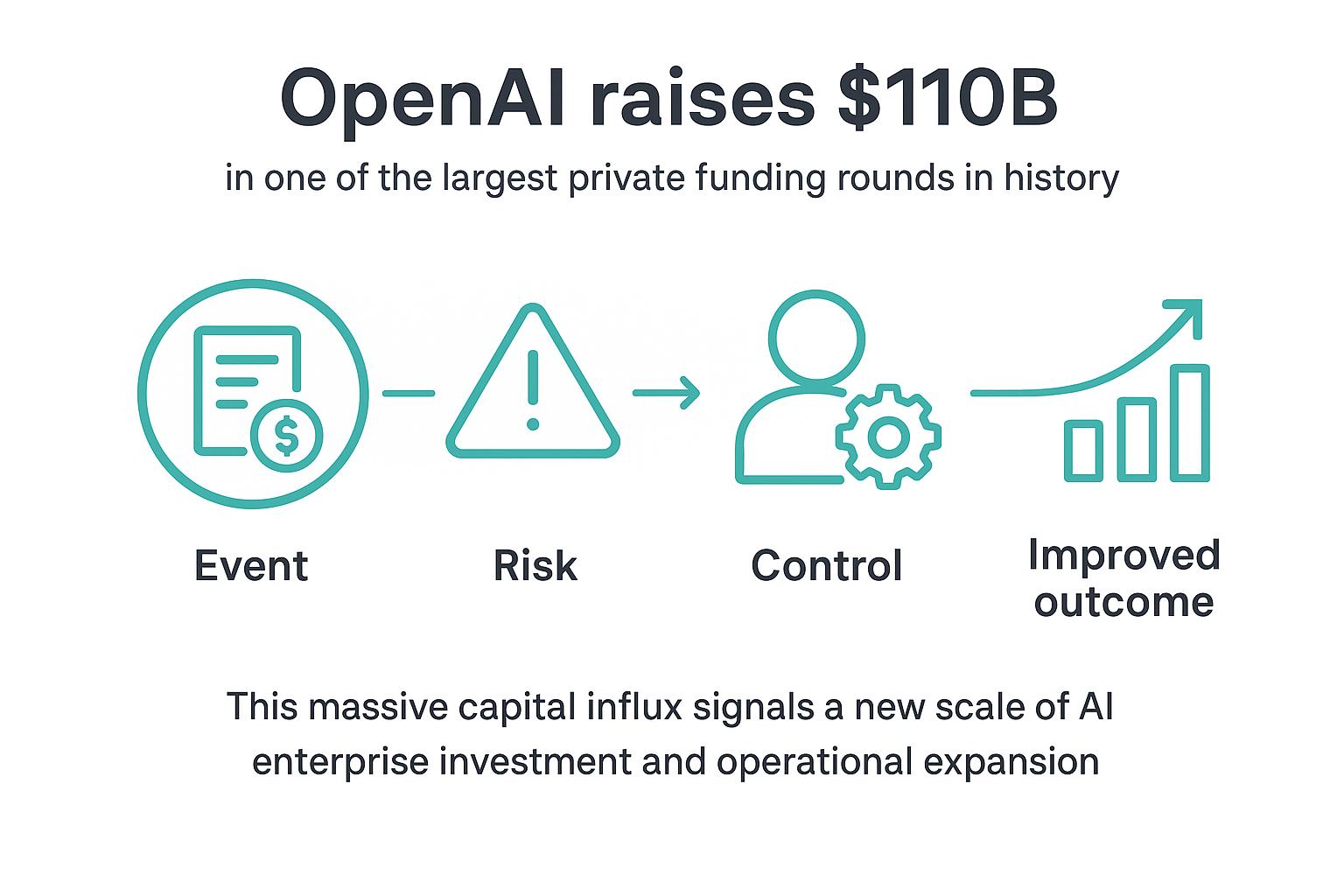
OpenAI has secured an unprecedented $110 billion in private funding, led by Amazon ($50B), Nvidia ($30B), and SoftBank ($30B), valuing the company at $730 billion. This massive capital influx signals a new scale of AI enterprise investment and operational expansion.
Source: TechCrunch (Main)
What Happened?
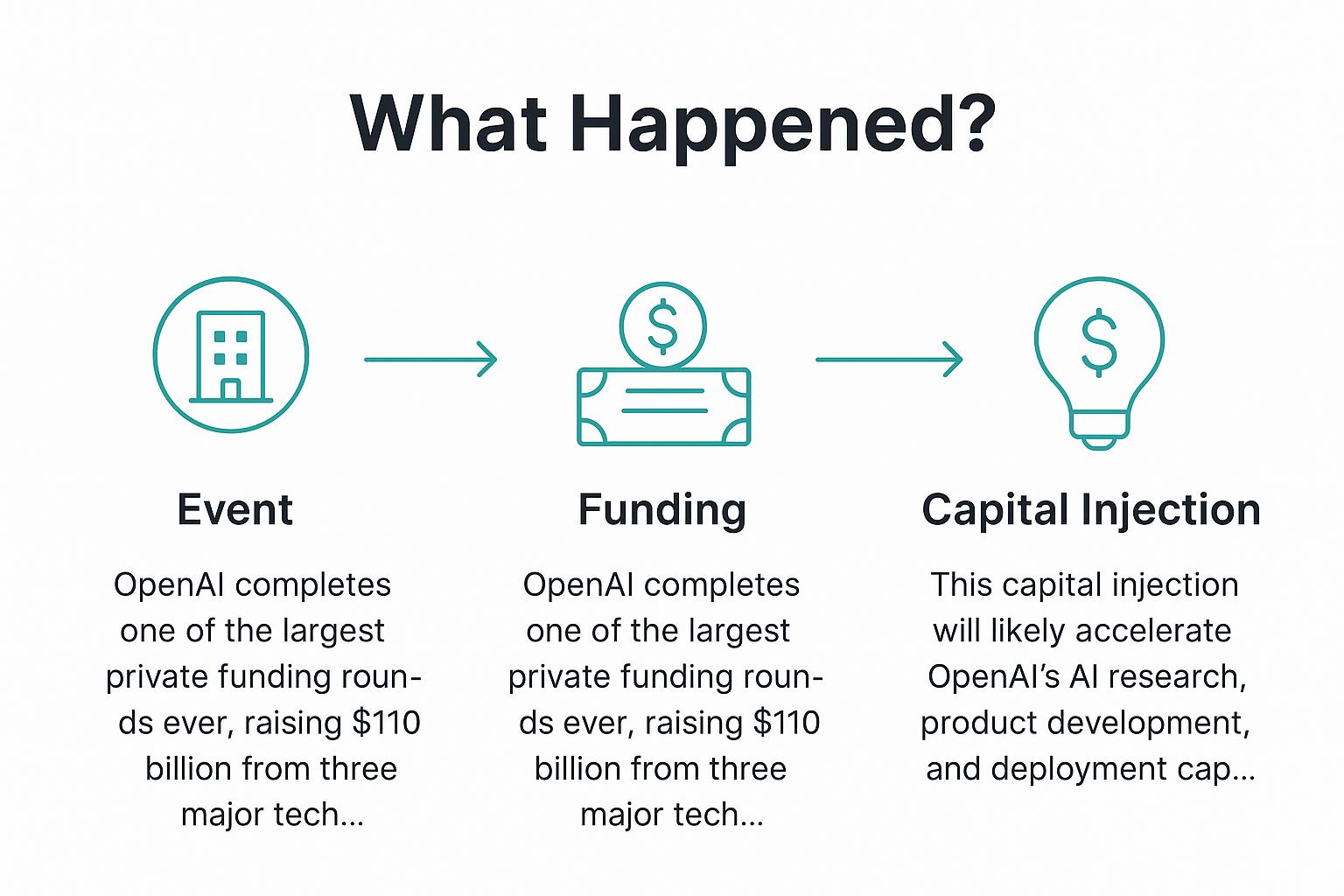
OpenAI completed one of the largest private funding rounds ever, raising $110 billion from three major tech investors. This capital injection will likely accelerate OpenAI’s AI research, product development, and deployment capabilities, potentially expanding their market influence and technological footprint.
What Are The Risks Involved?
Classification: Strategic and operational risk from hyper-scale funding in AI development.
Primary risk vector: Rapid scaling without commensurate governance and risk controls.
Risk |
Mechanism in this event |
Impact |
Mandatory vs Contextual |
Governance dilution |
Massive funding may outpace governance capacity |
Loss of oversight, increased operational risk |
Mandatory |
Concentration of influence |
Few investors hold outsized stakes influencing strategy |
Potential bias, reduced accountability |
Contextual |
Risk of accelerated deployment |
Large capital enables faster rollout of AI systems |
Increased exposure to untested AI behaviors |
Mandatory |
Compliance strain |
Scaling may challenge adherence to evolving regulations |
Regulatory violations, fines, reputational harm |
Contextual |
Transparency challenges |
Complex funding and growth obscure decision-making |
Reduced stakeholder trust and auditability |
Mandatory |
Who Is Affected?
- Strategy / Business / Product Owners: Face pressure to rapidly scale AI offerings; risk inheriting governance gaps from accelerated timelines. They define risk appetite and must enforce strategic control gates.
- Data, Privacy & Legal Teams: Must manage compliance risks amid rapid expansion; risk being overwhelmed by new regulatory requirements. They implement controls and escalate legal risks.
- AI Engineering & Architecture: Responsible for building scalable, secure AI systems; risk technical debt and insufficient validation under growth pressure. They detect failures and enforce technical standards.
- Responsible AI / Human Oversight: Oversight teams may struggle to maintain effective human-in-the-loop controls as deployment accelerates. They must approve risk mitigations and monitor drift.
- Cybersecurity / DevSecOps: Increased attack surface and complexity require enhanced security controls; risk operational breaches. They implement runtime defenses and incident response.
- Risk, Compliance & Incident Response: Must update risk frameworks to reflect new scale; risk missing emerging threats. They monitor, report, and escalate incidents.
- Audit & Assurance: Face challenges auditing complex, fast-evolving AI systems; risk incomplete assurance coverage. They provide independent verification and compliance checks.
- End Users / Impacted Stakeholders: Potentially exposed to unvetted AI behaviors and systemic risks from rapid deployment. They rely on governance to safeguard safety and fairness.
Synthesis: AI governance responsibility spans the entire lifecycle and organizational spectrum. Failures often arise at handoffs and silos, especially under rapid scaling. Cross-functional collaboration and shared accountability are essential. AI Policing AI communities can facilitate collective learning and governance-by-design.
Why This Matters for AI Governance?
This event creates a governance tension between unprecedented scale and the capacity for oversight. The rapid influx of capital enables faster AI deployment but strains existing governance frameworks, increasing risks of drift, opacity, and loss of human control. Accountability becomes harder to enforce as operational complexity grows. Without embedding governance into the scaling process, the risk of systemic failures and regulatory non-compliance escalates sharply.
How Governance Frameworks Apply (Practical)?
- NIST AI RMF: Govern investment-driven scaling by mapping new risk vectors, measuring governance capacity, and managing deployment pace with approval gates and runtime monitors.
- ISO/IEC 42001: Embed AI management system roles and change control processes to handle rapid growth and maintain audit trails.
- OECD AI Principles: Uphold accountability by assigning clear ownership for risk decisions and transparency through disclosure notes on funding impact and deployment changes.
- OWASP Top 10 for LLM Applications: Implement security controls to mitigate expanded attack surfaces due to scaling.
- Model Cards / System Cards: Update documentation to reflect new capabilities and risks introduced by accelerated funding and deployment.
What Needs to Be Built Next (Controls Blueprint)?
Control |
Purpose |
Lifecycle Stage |
NIST AI RMF Function |
Mandatory vs Contextual |
Evidence / Artifact |
Scalable Governance Framework |
Manage governance at scale |
Design & Deployment |
Govern |
Mandatory |
Policy-as-code, approval gates |
Investment Impact Risk Assessment |
Evaluate governance risks from funding scale |
Planning |
Map |
Mandatory |
Risk assessment reports |
Deployment Pace Control |
Limit rollout speed to maintain oversight |
Deployment |
Manage |
Mandatory |
Runtime monitors, audit logs |
Stakeholder Accountability Matrix |
Define roles and responsibilities across teams |
Design & Operation |
Govern |
Mandatory |
Accountability matrix |
Enhanced Audit Trails |
Track decisions and changes from funding impact |
Operation |
Measure |
Mandatory |
Immutable audit logs |
Security Hardening for Scale |
Address expanded attack surface |
Design & Operation |
Manage |
Contextual |
Penetration test reports |
Transparency Disclosures |
Communicate funding impact on AI capabilities |
Operation |
Govern |
Contextual |
Disclosure notes, system cards |
Regulatory Compliance Monitoring |
Monitor evolving compliance risks |
Operation |
Measure |
Contextual |
Compliance dashboards |
The Build — Governance by Design
Document-based governance alone cannot keep pace with hyper-scale funding and rapid AI deployment. Governance must be embedded into system design and operational workflows before deployment. This includes automated policy enforcement, real-time monitoring, and clear accountability baked into development pipelines and decision processes. Execution-level controls that operate at runtime are essential to prevent governance gaps from becoming systemic failures. Without this, governance remains theoretical and ineffective.
Governance that cannot be enforced at runtime is not governance.